Party to the Conflict: Eugene Fights Back Against the Feds
:On Spreading ICE Thin


At the end of January 2026, confrontations between Immigration and Customs Enforcement agents and the community at large reached a fever pitch in the Twin Cities, spreading to Portland and other cities around the United States—including locales less associated with high-profile protest activity. In the following account, a participant describes the outbreak of hostilities with federal agents and police that took place in Eugene, Oregon, exploring it as a microcosm of the resistance that is spreading ICE increasingly thin around the country.
Party to the Conflict
I know that the new world is real because sometimes a portal opens up, showing me a small glimpse into it. Sometimes it looks like a brick flying through the air, a tear gas canister returning to sender, a police line falling back.
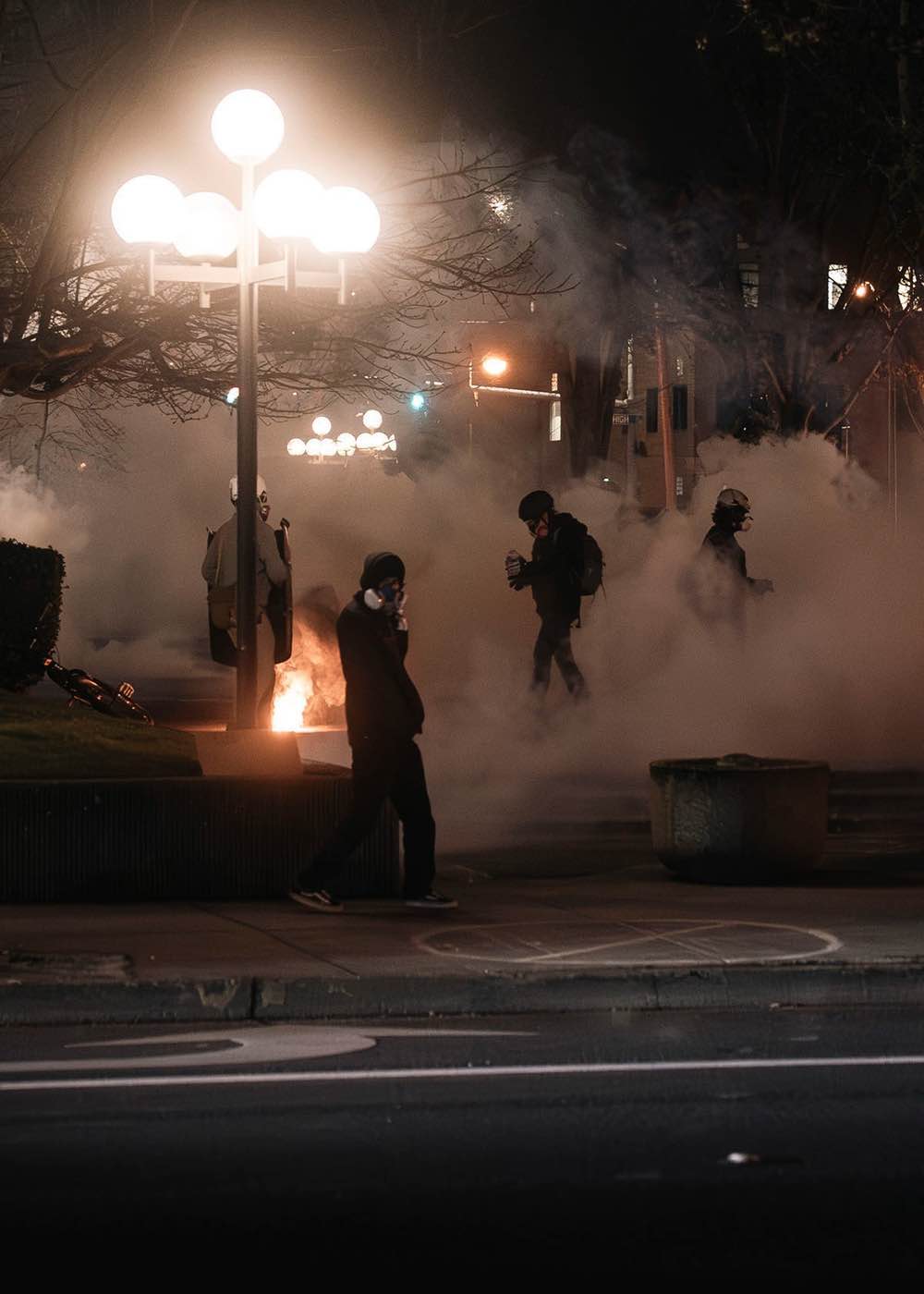
In Eugene, in late January, the portal to the new world opened up again and again. Clashes broke out between protesters and federal forces at their downtown headquarters, lasting hours at a time and culminating in a breach of the Federal Building on the night of Friday, January 29. These skirmishes brought together hundreds of Eugene residents, who have drawn inspiration from the clashes and protests in Los Angeles and the Twin Cities as well as a collective memory of our own history of struggle. This has been the most intense fighting with law enforcement in Eugune since 2020; it has inaugurated a new chapter in the struggle against ICE in our city.
Eugene prides itself on its history of protests and counterculture. Outsiders have asked whether what is happening in Eugene in 2026 represents a return to the riotous days of the 1990s, when Eugene was widely known as a center of ecological organizing and direct action. In fact, it is both an organic community response to the federal government’s ongoing campaign of ethnic cleansing and the latest manifestation of an insurrectionary reflex that developed in the wake of the George Floyd rebellion and the riots in summer 2020. You can read a comprehensive analysis of that period here. More recently, we have seen this insurrectionary reflex emerge in street battles with the far right and in a black bloc march on the federal building on May Day 2025.
Since summer 2025, community members have convened near-daily protests at the federal building that ICE uses as its base of operations. These protests have been popular, but for the most part, like the No Kings demonstrations, they have not escalated into direct confrontations with federal agents. There have been exceptions, such as one night in fall 2025 when officers from the Border Patrol Tactical Unit of Customs and Border Protection played cat and mouse with about a hundred protesters. Unfortunately, at that time, most demonstrators were not prepared to respond effectively, and suffered considerable abuse at the hands of the officers.
The killings of Renee Good and Alex Pretti changed things in Eugene. The tension and anger reached a boiling point. On January 24, the day of that Pretti was murdered, several hundred protesters amassed at the federal building for that day’s regularly scheduled demonstration. One banner read, “Two of Ours, All of Yours.”
The government of Eugene tried to get ahead of the anger by holding a town hall meeting at 1 pm that day with the mayor and city council in attendance. We have become familiar with this tactic in which they offer empty promises that something will be done. It usually results in a strongly worded letter, if that. Organizers from the Party for Socialism and Liberation led many protesters from the federal building to the town hall. As soon as everyone was inside the meeting hall, the planned session devolved into shouting and disruption.
On Tuesday, January 27, around 2 pm, Department of Homeland Security officers in tactical gear attacked a small group of protesters who were taking part in the weekly “Love and Rage” demonstration at the federal building. Until that day, they had usually ignored protesters; this time, they attacked the protesters with pepper balls and wrestled several people to the ground in order to drag them into the building.
Word spreads fast in a small city. Messages calling for support circulated over a variety of channels, along with footage showing masked DHS agents brutalizing people. Supporters trickled in as the agents pressed their attack. In the course of a few hours, they arrested half a dozen people. But this was only the first protest of the day: at 5 pm, the Oregon Nurses Association were scheduled to hold a vigil for Alex Pretti, drawing a larger crowd to the location.
The sight of hundreds of people rushing in to support those under attack by federal agents was powerful. Hundreds filled the courtyard, which is surrounded on three sides by the federal building; more people crowded the sidewalks at the nearby intersection.
The protest grew louder than the previous ones, with more aggressive chants. Yet at first, it lacked direction. Different groups tried to lead, pushing their own chants and efforts, all united by the sight of agents in tactical gear inside the building. Some years had passed since the last major clash and people were out of practice.
The protesters’ primary focus was to demand that the feds release the people they had captured earlier in the day. The crowd grew confrontational. A few protesters painted walls, shined lasers, and threw water bottles at the glass panels separating protests from federal agents. Anticipating a clash, many people donned protective gear such as respirators and helmets.
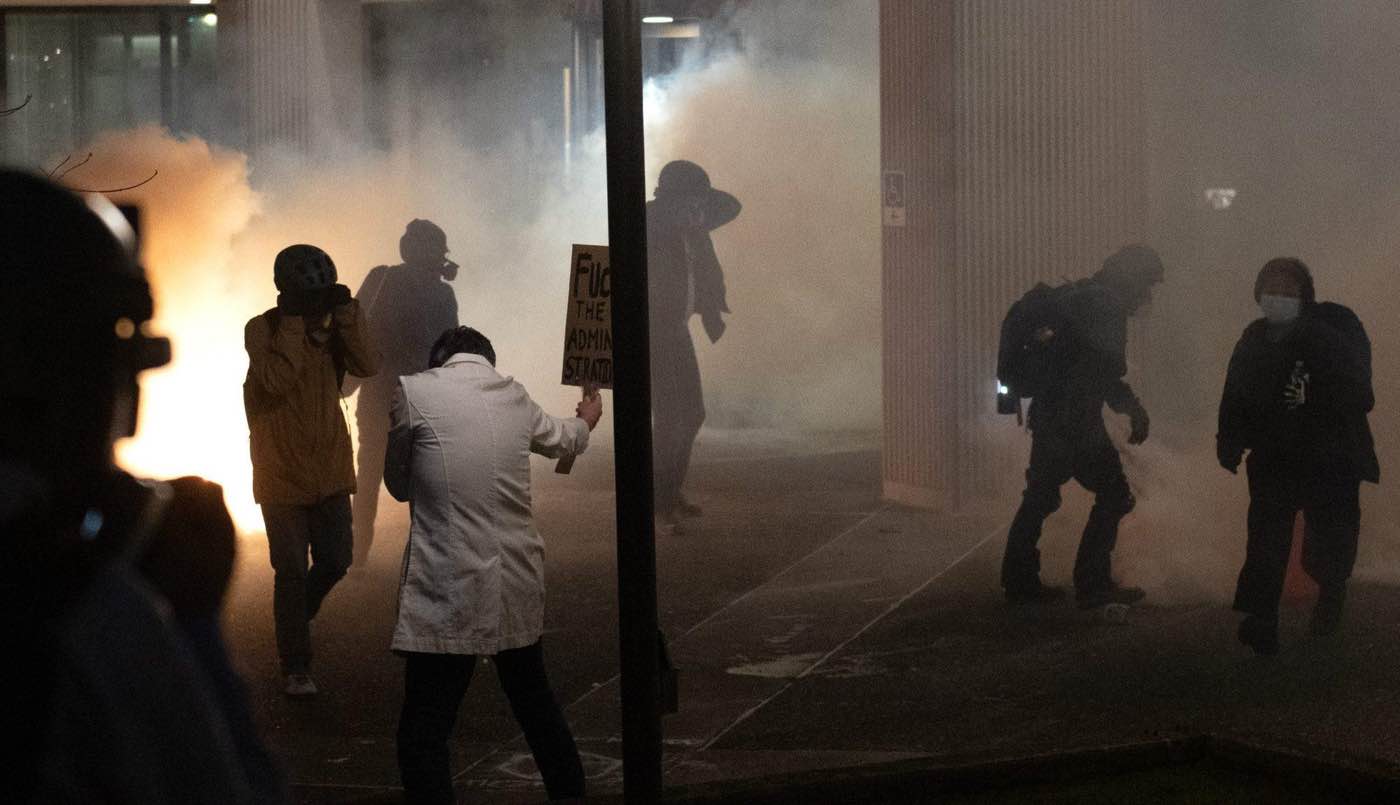
“Fuck the administration.”
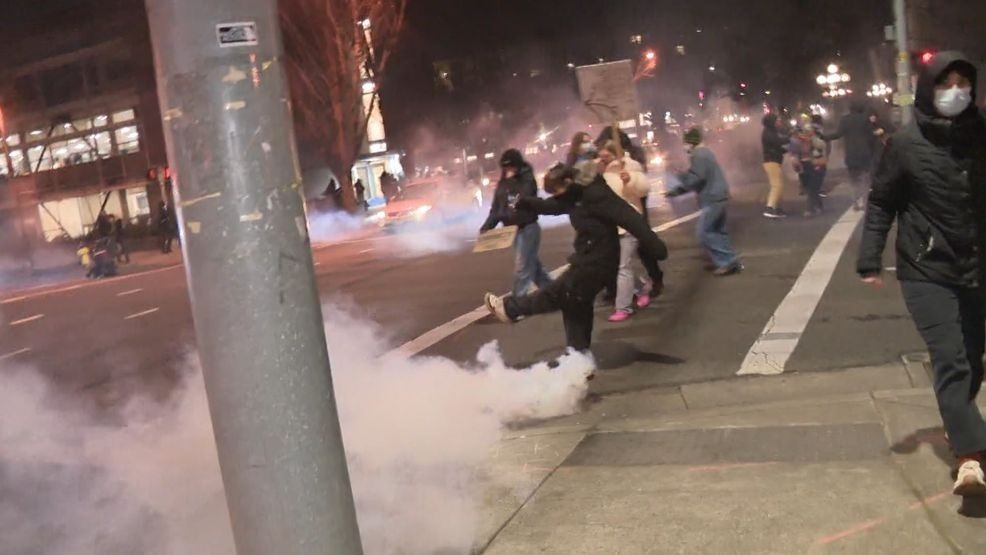
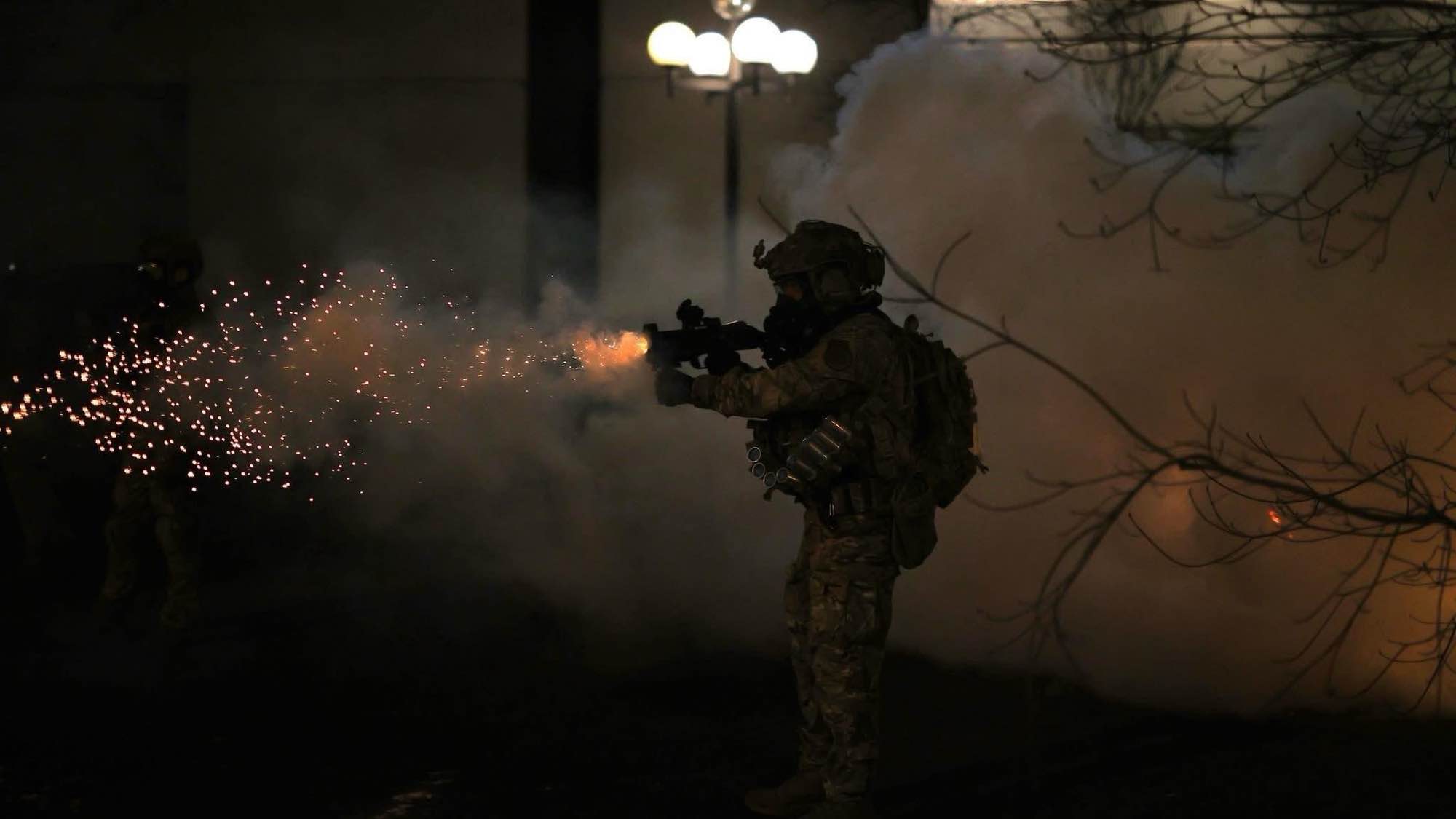
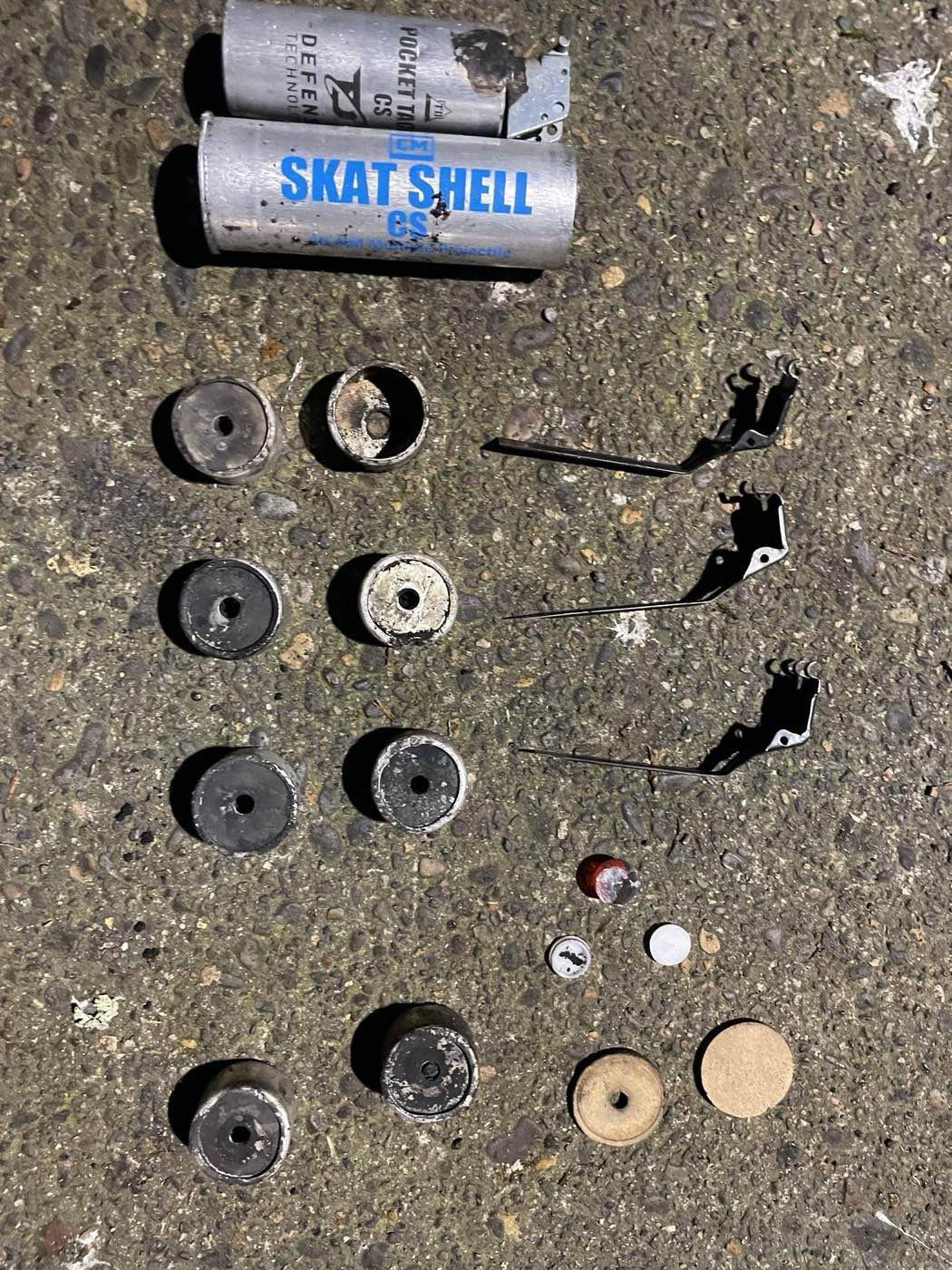
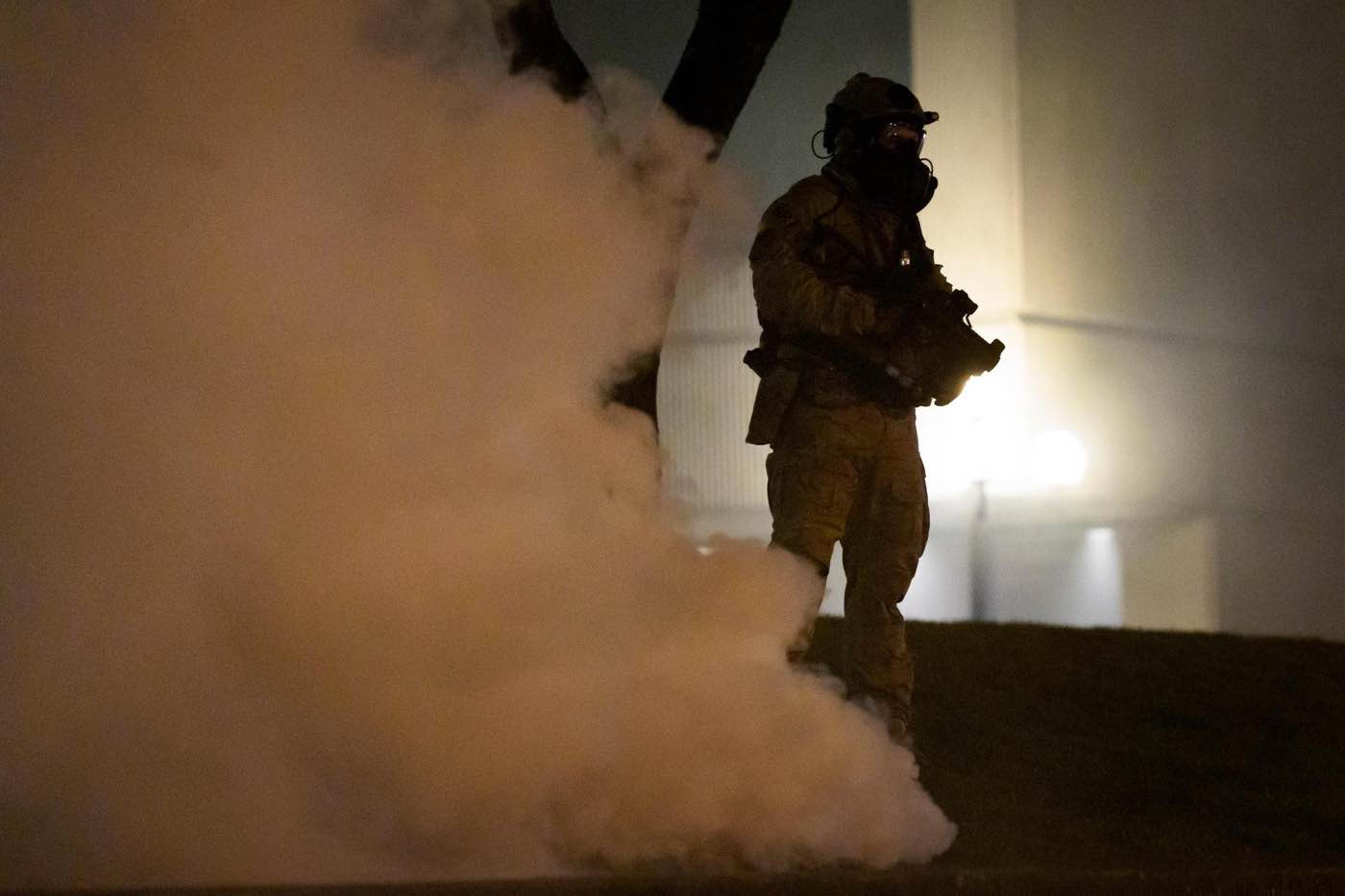
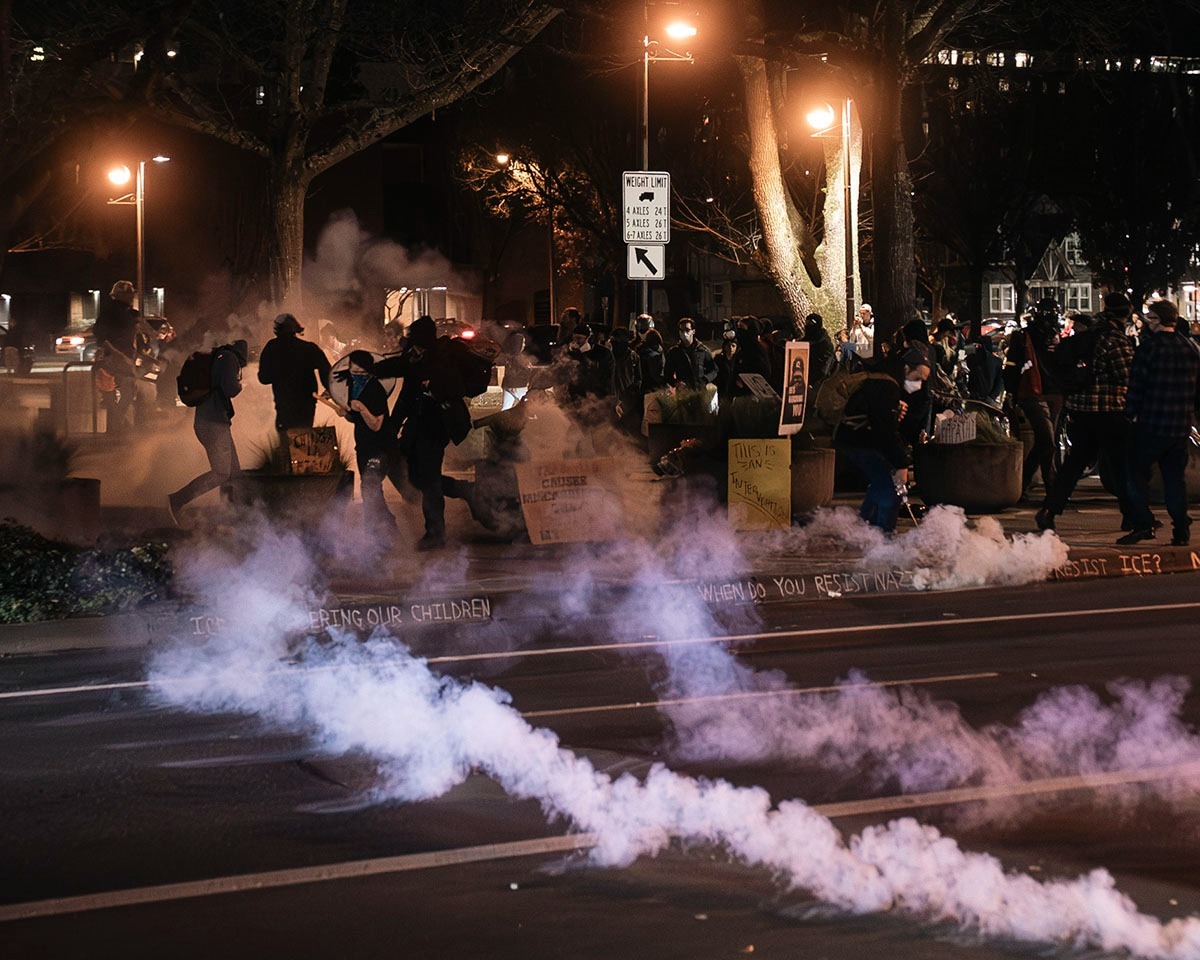
Around 7 pm, the ear-splitting sound of a flash-bang grenade resounded. Clouds of tear gas filled the plaza and spilled out into the surrounding streets. The crowd fell back without panic. Some protesters threw canisters back to the advancing line of federal agents; others extinguished the tear gas with water. Because the Oregon Nurses Association had organized the vigil, many of the participants knew how to deal with the noxious chemicals. They chanted “we are not afraid.”
Outnumbered, the feds retreated back inside the building, with hundreds advancing on them. Skirmishes between protesters and federal agents continued for several hours.
Eugene police officers did not arrive until 8 pm. They arrived by truck, decked out in riot gear, piloting drones overhead. However, they did not engage the protesters. Local police have hesitated to openly support ICE, maintaining operational distance. This has enabled them to launder their reputation, presenting themselves as the “lesser evil” law enforcement institution operating within the city, despite the daily terror that they too inflict in Eugene, especially upon the unhoused population.
Over the days that followed, even liberals struggled to denounce militant protesters. Eugene’s mayor, Kaarin Knudson, denounced ICE while expressing “concern” for community safety, as if ICE agents hadn’t been abducting people from the community before this. Never missing a chance to funnel energy back into institutional channels, the mayor also announced that the City—and its police—would develop a common strategy to deal with these situations going forward and that EPD would be more involved with policing protests.
Tear gas has a way of reengaging old friends and networks in the same way that the rain activates the spores that become the neon green moss for which the Pacific Northwest is known. It was inevitable that state violence would eventually bring people back into the streets. It was inevitable that the liberal city establishment would fail to calm the anger of the public, as they had no real leverage over the federal government. It was inevitable that concerted organizing, agitation, and preparation would pay off once social peace was no longer possible.
Eugene Punks United, a radical youth group known locally for organizing school walkouts, announced a demonstration at 2 pm on January 30, scheduled to coincide with the “general strike” taking place in the Twin Cities that day. Several other events were announced for this day, but the protest attracted a rowdy and prepared group hoping to “confront Nazi scum,” in the language of the call to action.
Enterprising participants in the crowd painted slogans on the federal building. Others broke windows. In response, outnumbered federal agents fired concussion grenades and tear gas into the crowd. This time, Eugene Police came to their aid. The authorities declared a riot and a pitched battle ensued. For nearly four hours, officers and demonstrators exchanged volleys of tear gas canisters, flash-bang grenades, bottles, fireworks, and other projectiles. The final salvo of tear gas canisters took place after midnight.
Like the looting and arson that followed George Floyd’s murder, the riot at the federal building represents a qualitative leap in Eugene’s recent history of struggle. It could mark a shift in the form that protests against ICE take. However, it did not receive the same widespread support that the January 27 clashes did. Public opinion is divided on whether things went “too far,” though the debate is less intense than the backlash after the looting on May 29, 2020. Some point to viral videos of federal agents breaking windows at the building to support conspiracy theories that they had broken their own windows. But in actuality, the windows had already been broken at that point—a fact that demonstrators should be proud of—and the officers were simply pushing away the wreckage in order to fire tear gas at demonstrators.
The state and local response to the events of January 30 was swift. Both of Oregon’s senators as well as Governor Tina Kotek held a press conference with the mayor of Eugene the next morning. They sought to establish a “good protester, bad protester” narrative, telling people “not to take the bait,” threatening consequences for those who engaged in property destruction or violence against the police. They implored protesters not to give the federal government a reason to target Eugene the way they have in Minneapolis, stating that Eugene could not handle a surge of thousands of ICE agents.
It must be said that the federal government did not intervene in Minneapolis because protesters “gave them a reason”—Trump sent thousands of ICE and Border Patrol agents because an extreme-right social media personality made a viral post alleging that fraud was taking place in the Minneapolis welfare system, not to mention because he has held a grudge against Minneapolis since the George Floyd uprising. If everyone everywhere fiercely resists federal agents, they will be spread too thin, with too little support, to be able to continue attacking other cities the way that they have attacked the Twin Cities. On the other hand, if people do as the aforementioned politicians urge and confine themselves to powerless symbolic protest, ICE will be able to assault one city after another, eventually reaching Eugene and countless others.
In addition to the response from state officials, Donald Trump denounced the protesters as “highly paid Lunatics, Agitators, and Insurrectionists” [sic], threatening to deploy troops to quell the protests. Yet he has made himself so many enemies all around the country that we should not take these threats at face value.
Since that Saturday, protests have continued at the federal building, which remains boarded up. The protests are smaller than they were in late January, but there will be more opportunities soon enough. There have been both confirmed and rumored sightings of the FBI, who have asked businesses near the federal building for footage and have attempted to question at least two community members.
Despite their threats, we must stay focused on the goal. We have a chance to contribute to ending the American nightmare once and for all by stretching their forces thin, which will create openings elsewhere. For every ICE agent deployed to defend the federal building, that’s one less out on the streets terrorizing and abducting people. The more force they use, the more everyone will come to see them as an illegitimate occupying army. The more we resist them, the more the warnings of local politicians and the threats of federal officials will ring hollow.
We hope that the growing backlash against the federal government that is unfolding around the country marks the beginning of a movement that can ultimately dismantle the techno-feudal police state that Donald Trump, Stephen Miller, Peter Thiel, Elon Musk, Sam Altman, and others are trying to build. With their defeat, we can push for a deeper and more decisive victory against the state and private property.
Whatever happens, we cannot and will not allow their world to take shape. If our movement must be forged in the crucible of federal occupation, then so be it. Victory belongs to those who fight for a righteous cause. Here’s to many more nights of action in Eugene. May the portal open once again, may we pass through once and for all.
Love to our fighters!
Rest in power, Keith Porter Jr., Renee Good, Alex Pretti, and so many more.